Ka'ana Boutique Resort Blog » Belize Wildlife


Archive for the ‘Belize Wildlife’ Category


Birds of Belize: King Vulture reigns Supreme!

November 14th, 2012

King Vulture  (Sarcoramphus papa)

Called the “King”, either because of his Royal coloring or demeanor, this magnificent bird is one of the four species of vultures that call Belize home.  Known to locals as “King Jan-Kro” or “King John Crow”, he is the largest vulture, hence all other birds make way for him once he lands.

He has an extremely thick and strong bill, well adapted for tearing, and the long, thick claws for holding the meat. A scavenger by nature, his keen eyesight and sense of smell allows him to locate potential food sources (carrion) easily as he scours over the savannas and forested lowlands he normally inhabits.

Although on the decline due to habitat destruction in the Central American Region, Belize still has large healthy populations. Go bird-watching with us, perhaps you just might spot one!


“To Travel is to Live.” Hans Christian Anderson

November 13th, 2012

Hiking on Victoria Peak, Belize.

Climbing Victoria Peak is an adventure few Belizeans or visitors get to experience. It’s 3,675 feet high but the going is mostly through tropical rainforest. The entire trip is approximately 40 miles and doing the hike usually takes about 4 nights and 5 days.

Ensure your backpack is fully equipped with all your necessary gear and equipment and your on your way to triumph when you hit the summit! No easy feat – it is said that less than 300 people have actually made it all the way to the top. Will you be one?


Photo Credit: mybelizeexperience.com


Happy Halloween! We are going to be a Sisimito. (That’s Belizean folklore for a ‘big foot’ type monster!)

October 31st, 2012

Tata Duende

Tata Duende translates to grandfather demon. He is depicted as an old mischievous character that is very short, with backward feet, wears a tall pointy hat and has both of his thumbs missing. If you ever saw him you couldn’t show him your hands as he’d surely cut off your thumbs. Parents also warned their children that if they skipped classes, Tata Duende would lure them into the jungle and they would never be seen again.

Tata Duende was also to blame when weird things happened around farms. He was to blame for destroying the neighbour’s crops. And once in a while he would braid a horse’s hair and it would have to be cut completely as it couldn’t be loosened.


  Sisemite/Sisimito

Sisemite or Sisimito is a tall hairy monster-like creature equivalent to Big Foot. Usually depicted as being a male, the Sisemite lived in Caves and survived by eating raw game meat. What he was commonly known for was kidnapping women and taking them to live with him. He would then force them to be his partner and bear children.

The Sisemite was said to commonly roam the river banks at dusk, therefore women were always warned by their mothers never to stay out late when they went to wash clothes at the river (a common practice in the old times).


La Llorona (pronounced la Yo-ro-na)

La Llorona translates to weeping woman. She is depicted as a tall and slender gorgeous woman with long black hair that reached her waist. No one could ever see her face unless they caught up to her.

There are several variations of what she did; one of the most popular versions was that she lured children to rivers found deep in the jungle, hoping they got lost. Legend says that she lost her children near a river and she did the same to others as a way of revenge.

La Llorona was also known for luring young men on their way home late from bars. Young men were warned by their parents not to stay out late drinking since if La Llorona caught up with them, they would never be seen again. La Llorona would charm drunk men into the forest and when they were far away from the town, she would show them her ugly and distorted face as she let off a shrieking cry. The men would either immediately die or fall terribly sick for weeks.

Info credit: http://www.belizeadventure.ca/get-to-know-belizean-folklore


Ka’ana’s Pet – A Green Iguana:

October 24th, 2012

This Green Iguana has been calling Ka’ana home – you can spot him sunning by the pool during lunch time. Not a bad life!


Hellos from Lamanai, Belize!

October 18th, 2012

Lamanai means “submerged crocodile” in the Maya language and it’s also the name of the third largest, and possibly most interesting, archeological site in Belize.

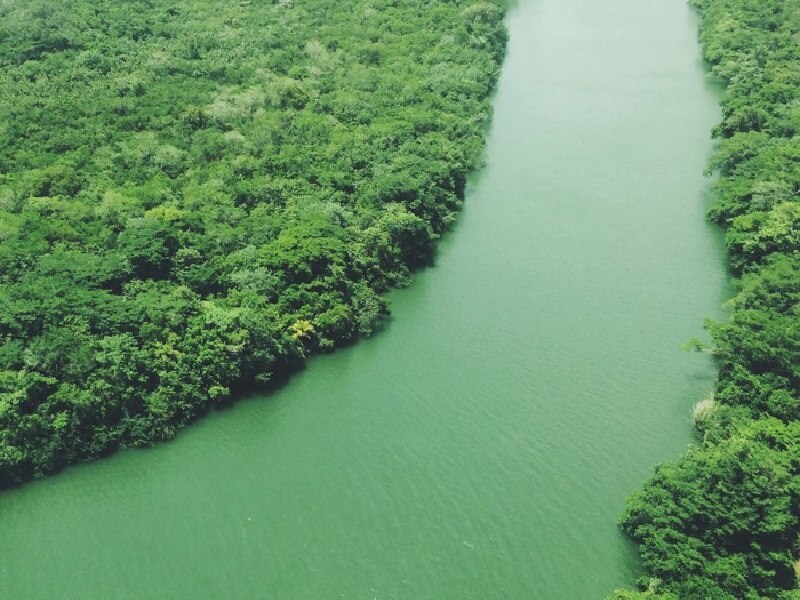
Located in the Orange Walk District, the Lamanai temple complex sits atop the western bluff of the New River Lagoon and is surrounded by pristine rainforest.

Lamanai was occupied continuously for over 3,000 years and it’s remoteness contributed to it’s continuous occupation, well beyond most other Maya sites, until at least 1,650 AD.

Set in tropical forest, and providing spectacular views from several of its large temples, Lamanai provides a unique experience into the culture of the Maya and the biological diversity of the tropical forest.

Lamanai features the second largest Pre-Classic structure in the Maya world and unlike other ruins, much of Lamanai was built in layers where successive populations built upon the temples of their ancestors, instead of destroying them.

Although hundreds of ruins are said to remain unexcavated in the nearby jungle, three of the most impressive temples have been renovated: the Jaguar Temple, named for its boxy jaguar decoration; the Mask Temple, adorned by a 13-foot stone mask of an ancient Maya king; and the High Temple, offering visitors a panoramic view from its summit.

What remains of two 16th century Catholic missions are also nearby. Maya natives rebelled and burned the churches to the ground as part of a regional uprising. A make-shift Maya stelae, standing in front of what remains of one church, is widely interpreted as renouncing all allegiance to Christianity.

The site’s protected status provides for an abundance of wildlife inside the park. There are a growing number off howler monkeys that make Lamanai their home and you will most likely see them peering down through the branches as you wander the trails. In addition, the marshlands around the lagoon supports many species of water birds and wildlife, including crocodiles.


We are all about personalized adventures!

October 17th, 2012

NYtimes article on travelers seeking bespoke itineraries, “There is a surge of people looking for the meaningful experience..” Be sure to check out our meaningful experiences and how you can participate here .

Read more of the article here.


This backpack has a secret hammock stashed inside! Imagine…you + hammock here: Big Rock Falls, Belize.

October 10th, 2012

Imagine you’re hiking back from a waterfall. You swam a little, and now need a disco nap… Luckily your backpack comes with a secret compartment and a hammock in it. Crisis averted!

Get your VSTR Nomadic Pack By Partners & Spade here.

Location: Big Rock Falls is 45minutes away from Ka’ana, see where else you can hike here.


“There is no certainty; there is only adventure.” – Roberto Assagioli

October 3rd, 2012

“There is no certainty; there is only adventure.” – Roberto Assagioli

We are always up for adventure – if it’s not hiking through the jungle, it’s zip-lining through trees, or exploring mysterious caves. We also love to travel and explore. Ready to start? Click here.


10 REASONS TO BE IN BELIZE RIGHT NOW!

October 2nd, 2012

1. It’s the end of the world. - The Mayan calendar ends December 21st, better take a vacation! We are taking off $100 each night until then, so your wallet takes a break too: Calendar Countdown.

2. Perpetual summer. - The average temperatures in Belize is in the mid 80′s. Go ahead, live in your swim suit!

3. Say hello to fried jacks. – Belize’s answer to a doughnut. It’s even better with the local jellies. Of course we offer this in our restaurant, La Ceiba.

4. 2 for 1. - See both Sand & Stone: Belize has both Caribbean and Jungle (ahem- Maya ruins!) basically 2 vacations in one! See your Jungle Accommodations here.

5. The Mayan underworld.- See some dark history and explore like Indiana Jones through ancient cave systems. Check out our full list of Excursions.

6. Jaguars? We’ve got a lot.- Belize has the healthiest population of Jaguars. Here kitty, kitty.

7. Reef it up.- Belize has the healthiest barrier reef in the world.

8. Get your cultural fix.- What country has Maya, German decent Mennonites, Garifuna, Mestizo, and Creole all under one roof?

9. Hop, skip and a jump. -Belize is 4 hours from New York, 1 1/2 hrs from Miami, and about 5 hours from LA.

10. Don’t be lost in translation.-Belize is English speaking, so no subtitles needed!


Our Picks for Belize’s Top 10 Coolest Wildlife:

August 15th, 2012

Belize is Home to many Amazing Creatures but if we had to narrow it down, here’s our Top 10 fave Belize animals:

1. Jaguar – You already know why, they’re stealthy and chic in motion. The chances of really seeing them in the wild are very rare but don’t fret, just hop over to the Belize Zoo nearby!

2. The Keel-billed Toucan-  This strikingly colorful bird is also the National Bird of Belize.

3. Jesus Lizard – Don’t be fooled by its dead stillness or its cute little dinosour look. If you get close enough to touch it, before you even see it move, it will have your finger in a vice grip with its razor sharp teeth and won’t let go until it feels you have shed enough blood for it to make a run for it, and it does that so fast too, that’s why it can run across water before it has time to sink!

4. Maya Coral Snake – This beautiful Maya Coral Snake can be very difficult to see and her neurotoxic venom is the most dangerous in Belize.

5. Whale Sharks – The Whale Shark is the largest fish in the world, and one of the largest creatures of any kind alive today. And they love Placencia as much as we do!

6. Howler Monkeys – Usually hanging around all the Maya ruins, when they howl you may confuse them for a certain dinosaur (Understandable since Spielberg used them in Jurassic Park for T-Rex’s vocals!).

7. King Vulture – Known as “King Jancro” in Belize, is the largest and most colorful of the four species of vultures in Belize. Their extremely thick and strong bill is well adapted for tearing, and their long, thick claws for holding the meat.

8. The  male Green Iguana – Despite its name, becomes larger and orange in color during its breeding season. It is protected and can grow 6 feet in length.

9. Sea Turtles (Green, Hawksbill, Leatherback and Loggerhead) can be seen in the waters of Belize. They live at sea and the females come ashore only to lay their eggs.

10. Crocodiles – Belize is home to 2 types: the American Crocodile can live in both saltwater and freshwater, while the smaller Morelet’s Crocodile lives only in freshwater. Both are on the Endangered Species list.