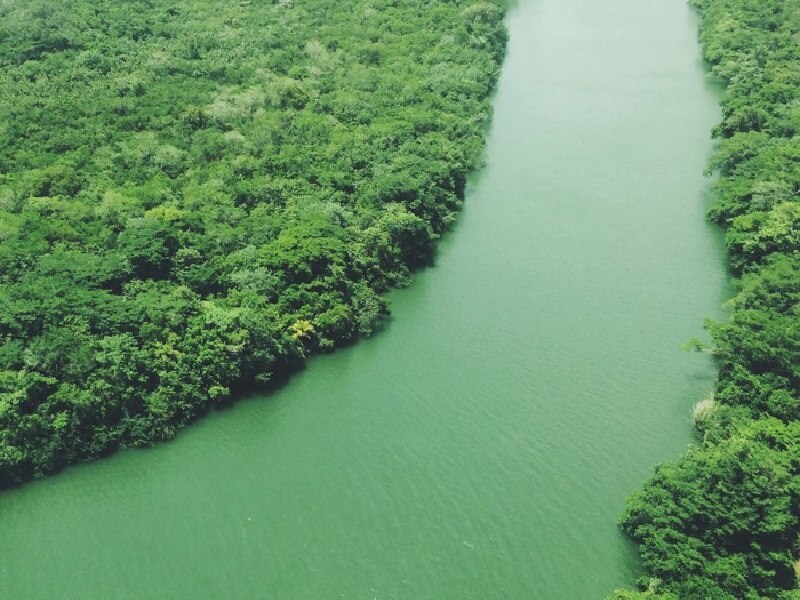
Adrenaline junkies get ready for the ultimate adventure duo: Ziplining high above the jungle canopy and later floating through cavernous sanctuaries where Mayas once performed their sacred rituals with only your guide and headlamps to lead the way. Check out more details here.
Thrill-seekers have the rare opportunity to spend the night on an ancient Mayan ruin in a luxury tent resembling a suite at Ka’ana, without having to sacrifice the comfort and amenities of the Belizean luxury resort. Ka’ana takes ‘glamping’ to the next level, beginning with a ride through the Belizean jungle next door into Guatemala’s Yaxha National Park. Enter the 1,100-year-old city just after dusk where an expert guide will lead guests to their meal prepared by a local Mayan cook at the base of the ruins.
After dinner, the guide will lead the ascent to highest temple where guests can enjoy views of the Guatemalan countryside while an archaeologist waxes historical about the intricate excavation of the Yaxah Temple. At the end of the evening, guests retire to their luxury digs — a replica of the rooms at Ka’ana, complete with a king-sized bed. The Morning After: Cross Lake Yaxha via boat to visit another, not-yet-excavated Topoxte Maya ruins. kaanabelize.com; packages starting at $2,000
T H E E X P E R I E N C E E D I T I O N
40 WWW.ATLANTATRIBUNE.COM
Be one of a small handful of people able to spend a night on a Mayan ruin by booking a stay at Ka’ana in Belize. After a few days at their luxe spot in San Ignacio, you’ll helicopter into the jungles of the Chiquibul Forest Reserve and camp out among the ruins of Caracol, the largest Maya city in Belize, with a tour by the country’s Director of Archaeology. Pass the time sampling hearty Mayan fare or take on a torchlit visit to a cave known for human sacrifices—just in case.
Check out other ways to tackle the apocalypse here.
We took a helicopter ride this weekend overseeing the natural beauty of Belize. This unique adventure took us over the Maya Mountains, which practically covers the lower half of Belize. This trip can be taken from Belize airport straight to Ka’ana’s own on site helipad.
It comprises of the Blue Hole National Park (665 ac.), (not to be confused with the “Blue Hole” atoll in the Barrier Reef), the Chiquibul National Park (265,262 acres) and Caracol, the Cockscomb Wildlife Sanctuary and Jaguar Reserve (96,000 acres), the Five Blues Lake National Park (4,060 ac.), the Mountain Pine Ridge Forest Reserve and the Colombia Forest Reserve.
Next up, our eyes were glued to a stunning waterfall somewhat hidden in a crescent of a large mountain. This is actually the largest waterfall in Belize and in Central America; called 1000 ft Falls. This has recently been proclaimed a National Monument and has been opened to the public. Even though the name suggest otherwise, this waterfall is closer to 1,600 feet. This isn’t the only waterfall- there’s many around this area.
After viewing all these amazing waterfalls, we then flew over Caves Branch where we were able to see the beauty of the river as it flows through the cave system. This area encompasses 58,000 acres that are situated beneath a 100 ft rainforest canopy and is bordered by turquoise waters of Caves Branch River.
We then flew across the Sibun Forest Reserve and finally the Southern and Northern Lagoons as we headed for our final landing on the helipad at Ka’ana Resort with these unforgettable images forever imprinted in our heads.
Lamanai means “submerged crocodile” in the Maya language and it’s also the name of the third largest, and possibly most interesting, archeological site in Belize.
Located in the Orange Walk District, the Lamanai temple complex sits atop the western bluff of the New River Lagoon and is surrounded by pristine rainforest.
Lamanai was occupied continuously for over 3,000 years and it’s remoteness contributed to it’s continuous occupation, well beyond most other Maya sites, until at least 1,650 AD.
Set in tropical forest, and providing spectacular views from several of its large temples, Lamanai provides a unique experience into the culture of the Maya and the biological diversity of the tropical forest.
Lamanai features the second largest Pre-Classic structure in the Maya world and unlike other ruins, much of Lamanai was built in layers where successive populations built upon the temples of their ancestors, instead of destroying them.
Although hundreds of ruins are said to remain unexcavated in the nearby jungle, three of the most impressive temples have been renovated: the Jaguar Temple, named for its boxy jaguar decoration; the Mask Temple, adorned by a 13-foot stone mask of an ancient Maya king; and the High Temple, offering visitors a panoramic view from its summit.
What remains of two 16th century Catholic missions are also nearby. Maya natives rebelled and burned the churches to the ground as part of a regional uprising. A make-shift Maya stelae, standing in front of what remains of one church, is widely interpreted as renouncing all allegiance to Christianity.
The site’s protected status provides for an abundance of wildlife inside the park. There are a growing number off howler monkeys that make Lamanai their home and you will most likely see them peering down through the branches as you wander the trails. In addition, the marshlands around the lagoon supports many species of water birds and wildlife, including crocodiles.
NYtimes article on travelers seeking bespoke itineraries, “There is a surge of people looking for the meaningful experience..” Be sure to check out our meaningful experiences and how you can participate here .