The jade head was discovered at in the Belize District’s Mayan site of Altun Ha in 1968 by Dr. David Pendergast of the Royal Ontario Museum of Canada. The head, along with forty other objects, had been placed within a large tomb that was located below the stairblock on the Temple of the Masonry Altars. At the center of the tomb were the remains of an elderly adult male. This elite person was likely an important ruler of the site during his lifetime and may have commissioned an artist to produce the large carved object. We do not know the exact date that the head was carved, but analysis of cultural remains within the tomb suggests that the burial, and accompanying grave goods, were deposited in the structure sometime between 600 and 650 A.D.
Weighing 9.75 pounds and standing almost 6 inches high, the jade head remains the single largest carved jade object yet discovered in the Maya area. Its crossed eyes, fang-like elements on either side of the mouth, and the ahau glyph on the forehead all identify the head as a representation of the Maya sun god Kinich Ahau. Along with Chac (rain god) and Yum Kax (corn god), Kinich Ahau was among the most important deities in the Maya pantheon.
The Kinich Ahau head is truly a remarkable object and exquisite work of art. It is the only one of its kind in all of Mesoamerica. Because it was carved with nothing more than stone tools, we know that it may have taken many months, if not years, to produce. It was also carved from one large solid piece of jade that was imported from the Motagua River Valley region of Guatemala. Jade was also the most precious of stones to the Maya. Beside its exotic origins, its green colour reflected that of water and the corn plant, the two most precious, life sustaining substances to the ancient Maya of northern Belize.
As it undoubtedly was to the prehistoric inhabitants of Altun Ha, the jade head continues to be a most important icon to the people of Belize today. It is prominently displayed on all Belize currency and has become an important symbol of our nation.
(CNN) — Protected rainforests, Maya ruins, Caribbean beaches and the longest barrier reef in the western hemisphere. Add English as the official language and the widely accepted U.S. dollar, and you can get a great vacation on easy mode in Belize.
Still, with so much to do, it can become a lot of work to fit it all in. Travelzoo editor Andrew Young recommends taking on just a little bit of this country in the heart of Central America at a time, and offers this list of his five top spots to get you started.
The Blue Hole
Just off the coast of Belize lies an underwater paradise for novice snorkelers and veteran divers. The Blue Hole is world-renowned as an open-water diving spot. During the Pleistocene era, the Blue Hole was a giant cave on dry land. The stalactites and stalagmites remain and are staggering sights through the crystal blue water.
Ambergris Caye
Ambergris Caye is the largest island of Belize, accessible via a small airplane from the mainland of Belize. Believe it or not, the best way to tour Ambergris Caye is by golf cart. Drive around and stop to see mangrove trees, the Belize Barrier Reef that almost touches the shore andlagoons teeming with crocodiles.
Maya ruins of Lamanai
Some use Belize as the entry point to Tikal, the famed ruins in Guatemala, but it is also home to several ancient Maya cities. One of the more interesting is Lamanai, which was still occupied by the Maya when the Spanish first arrived. The cultural collision is forever noted here, between the pyramids and the ruins of two Spanish churches.
Caves Branch River tubing
Geologists recently stumbled across a vast subterranean network of Maya ceremonial caves. At the Nohoch Che’en Caves Branch Archeological Reserve, guides will lead you across jungle pools to the caverns filled with artifacts like sacrificial skeletons. The spiritual underwater history lesson is a must-do.
Cockscomb Basin Wildlife Sanctuary
Interested in the chance see a jaguar up close and personal? The Cockscomb Basin Wildlife Sanctuary is the world’s first jaguar sanctuary. And, it’s also a campground where you can pitch your tent, go hiking, and listen to a symphony of jungle sounds.
We’re loving Trip Advisor’s review of Awe-inspiring places to visit (especially since Belize’s Blue Hole is also featured)! Commentaries are all real reviews from visitors to these places.
1. Antelope Canyon, Arizona, United States
“This is a photographer’s paradise. Pictures rarely do it justice.”
2. The Great Blue Hole at Lighthouse Reef, Ambergris Caye, Belize
“Here’s a great landmark… one of the top ten scuba diving sites in the world.”
3. Angkor Wat, Siem Reap, Cambodia
“The biggest and most stupendous of all the temples.”
4. Trolltunga, Odda, Norway
“Unbelievable… long hike, but once you get to the Troll’s tongue it is instant gratification.”
5. Golden Circle Route, Reykjavik, Iceland
“This scenic driving route through southwestern Iceland features excellent scenery and major sights.”
6. Moraine Lake, Alberta, Canada
“Spectacularly beautiful and the backdrop of the mountains makes it just stunning.”
7. Kyaikto (Golden Rock), Yangon, Myanmar
“Visiting the Golden Rock is an adventure… view from the mountain ridge is fantastic.”
8. Fushimi Inari Shrine, Kyoto, Japan
“It’s amazing to walk in those red tunnels… it all feels ancient and magical”
9. Uluru, Northern Territory, Australia
“The sunrise/sunset and the way the rock changes color is just amazing…”
10. Jiuzhaigou World Heritage Site, Sichuan, China
“It’s highly unlikely you will see landscapes like this anywhere else in the world.”
We asked Ronan (Half the dynamic Duo of the Hannan brothers – ahem – owners.) about his experience diving Belize’s famous Blue Hole!
What was your first thought when you saw the Blue Hole?
First sight of the Blue Hole – way bigger than it looks in photos. Everyone has seen photos of it from the air but when you get there it is pretty incredible since it is such a perfect circle even with such a large diameter – boating from one side to another takes a while! Overall one of the greatest things about going to the Blue Hole is actually “going” to the Blue Hole. It does takes a couple of hours to get there, but as you stop to snorkel or dive, viewing the spectacular colors of the reefs and marine life along the way, you can’t help but be amazed with its awesomeness.
Was this your first time scuba diving?
No. I learned to dive on Ningaloo Reef in Western Australia. I’ve dived the Great Barrier Reef, as well as in the Maldives and numerous other warm water destinations. I have to admit I have never dived in cold water!
How does the Blue Hole experience compare with other scuba diving excursions?
The Blue Hole is a very different diving experience due to its size, and obviously fish need to feed, so away from the walls there isn’t much sea-life. In the center it can get quite confusing as to which way is up and which way is down! It’s like an abyss! But over by the wall there are multiple stalactites and innumerable small cave systems. This is where the sharks hang out so its certainly interesting from that perspective. It is one of those dives that any diver absolutely has to do in their lifetime!
Lamanai means “submerged crocodile” in the Maya language and it’s also the name of the third largest, and possibly most interesting, archeological site in Belize.
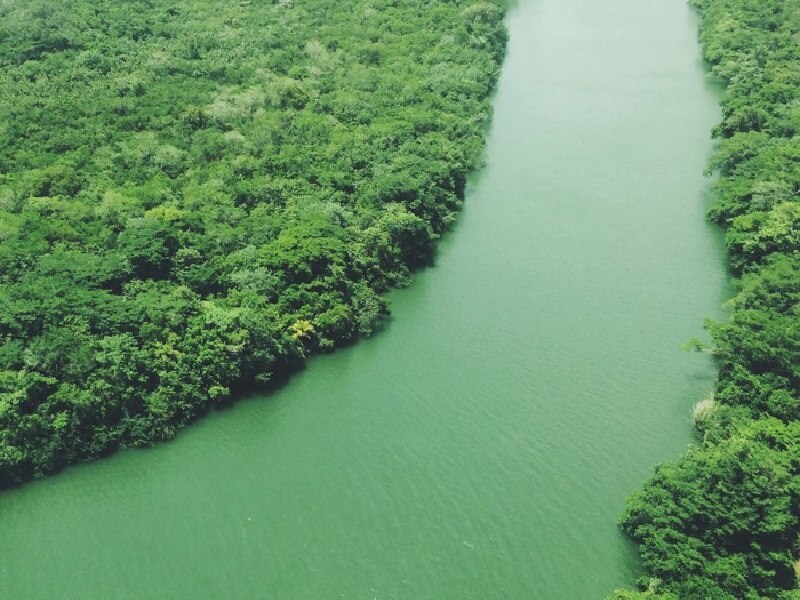
Located in the Orange Walk District, the Lamanai temple complex sits atop the western bluff of the New River Lagoon and is surrounded by pristine rainforest.
Lamanai was occupied continuously for over 3,000 years and it’s remoteness contributed to it’s continuous occupation, well beyond most other Maya sites, until at least 1,650 AD.
Set in tropical forest, and providing spectacular views from several of its large temples, Lamanai provides a unique experience into the culture of the Maya and the biological diversity of the tropical forest.
Lamanai features the second largest Pre-Classic structure in the Maya world and unlike other ruins, much of Lamanai was built in layers where successive populations built upon the temples of their ancestors, instead of destroying them.
Although hundreds of ruins are said to remain unexcavated in the nearby jungle, three of the most impressive temples have been renovated: the Jaguar Temple, named for its boxy jaguar decoration; the Mask Temple, adorned by a 13-foot stone mask of an ancient Maya king; and the High Temple, offering visitors a panoramic view from its summit.
What remains of two 16th century Catholic missions are also nearby. Maya natives rebelled and burned the churches to the ground as part of a regional uprising. A make-shift Maya stelae, standing in front of what remains of one church, is widely interpreted as renouncing all allegiance to Christianity.
The site’s protected status provides for an abundance of wildlife inside the park. There are a growing number off howler monkeys that make Lamanai their home and you will most likely see them peering down through the branches as you wander the trails. In addition, the marshlands around the lagoon supports many species of water birds and wildlife, including crocodiles.
NYtimes article on travelers seeking bespoke itineraries, “There is a surge of people looking for the meaningful experience..” Be sure to check out our meaningful experiences and how you can participate here .
Reviewed August 31, 2012 by Linda O from Pen Argyl, Pennsylvania
When we arrived at Ka’ana for our five night stay, we were greeted with friendly welcomes, smiles and a wonderful ginger and lime drink. (Onil, I would like the recipe!) Once refreshed from our travel, one of the concierges, Iera, met with us in the wine cellar. We conversed about everything from in town dining and shopping to tours. Once decided, she arranged our tours with a local tour company they use; awesome! Ka’ana staff took us to San Ignacio, then promptly picked us up with a local restaurant phone call to the resort. Our Balam room was always clean and every evening, our bed would be turned down, candles lit and yummy pastry was waiting for us! It was a wonderfully relaxing atmosphere. The grounds were well kept and inviting. Special thanks to Onil, Iera, Melvin and all the Ka’ana staff! Thank you all for making our vacation un-Belize-able! We will remember you, always. Ka’ana is the place to stay if you want relaxation or adventure. You will love it and never forget it! It was beautiful!
The Owner’s recount of their first time at ATM Cave (actun tunichil muknal)!
What was your first impression when you saw the cave opening?
It was a little intimidating because there’s a big pool that goes into the entrance and our guide, Wilbert, looks to us and says we are suppose to swim into the mouth. You just hold your breath and jump in.
What was your favorite part of ATM?
Climbing (and swimming) into different cathedrals of the cave, they are massive!
What did you see while exploring?
It’s amazing because you walk along history following what the Maya did to reach out to their gods. Lots of ceramic pots, cave drawings and even human remains!