Thrill-seekers have the rare opportunity to spend the night on an ancient Mayan ruin in a luxury tent resembling a suite at Ka’ana, without having to sacrifice the comfort and amenities of the Belizean luxury resort. Ka’ana takes ‘glamping’ to the next level, beginning with a ride through the Belizean jungle next door into Guatemala’s Yaxha National Park. Enter the 1,100-year-old city just after dusk where an expert guide will lead guests to their meal prepared by a local Mayan cook at the base of the ruins.
After dinner, the guide will lead the ascent to highest temple where guests can enjoy views of the Guatemalan countryside while an archaeologist waxes historical about the intricate excavation of the Yaxah Temple. At the end of the evening, guests retire to their luxury digs — a replica of the rooms at Ka’ana, complete with a king-sized bed. The Morning After: Cross Lake Yaxha via boat to visit another, not-yet-excavated Topoxte Maya ruins. kaanabelize.com; packages starting at $2,000
T H E E X P E R I E N C E E D I T I O N
40 WWW.ATLANTATRIBUNE.COM
A picture can say a thousand words right? We handpicked our top 10 Belize Travel Images that depict everything from flora, fauna and everything else that makes Belize – well, Belize. Send us your favorite images!
1. The ‘Mother of all Caves’ .. Actun Loch Tunich ! This expedition starts off with a vigorous hike into the foothills of the Maya Mountains. The edge of the Actun Loch Tunich sink hole sits over 300 feet above the basin below, 200 feet above the rainforest canopy that grows out from the sink hole basin.
2. Jaguars are found throughout Belize in the lowland forests and along the coasts. Adult jaguars are solitary and only come together for a short time to breed. Belize, however, has one of the healthiest populations in Central America, and the Jaguar is protected from hunting throughout Belize. You can book a tracking expedition with us to see these magnificent creatures in their natural habitat.
3. This flashy and iridescent blue butterfly is the beautiful Blue Morpho that is widely known throughout Belize. Look carefully and you will see them all around our property.
4. The green iguana, known locally as “bamboo chicken”, is the largest lizard in Belize and one of the largest in the world. It is often found perched on a branch overhanging a river, and when threatened will plunge into the water for safety.
5. They are one of 3 types of rays inhabiting the waters of Belize. The spotted eagle ray is covered with large white and cream-colored spots on dark background and has a white underbelly. These rays can be found along reefs, walls and sandy areas, including shallow areas. Spotted eagle rays generally swim alone, although they are sometimes observed in pairs and occasionally schools.
6. Belize’s national flower is the Black Orchid. The flower is actually not black at all but deep purple or violet in color. It is one of the few Orchids that flowers all year long.
7. The Maya are just one part of the rich melting pot of cultures that exist in Belize. Their vibrant Maya history and culture is respected and celebrated in Belize and the world.
8. Red Eyed Leaf Frog: The red eyed leaf frog lives on leaves. This frog is nocturnal; hunts at night and sleeps during the day. In the forests of Belize, the Red-eyed tree frog minimizes water loss by resting underneath leaves and tucking its limbs up close to its body.
9. The falls here at Davis Falls are about 500 feet high and are the second highest in the country (after 1,000-Foot Falls in the Mountain Pine Ridge), and the natural pool at the base of the falls is 75 feet deep. The swimming is wonderful, and the undisturbed forest around the falls is great for a picnic or enjoying nature.
10. You never know what color palette the sunsets in Belize will bring you. It is ever-changing, ever so beautiful and nothing short of spectacular each and every day.
We asked Ronan (Half the dynamic Duo of the Hannan brothers – ahem – owners.) about his experience diving Belize’s famous Blue Hole!
What was your first thought when you saw the Blue Hole?
First sight of the Blue Hole – way bigger than it looks in photos. Everyone has seen photos of it from the air but when you get there it is pretty incredible since it is such a perfect circle even with such a large diameter – boating from one side to another takes a while! Overall one of the greatest things about going to the Blue Hole is actually “going” to the Blue Hole. It does takes a couple of hours to get there, but as you stop to snorkel or dive, viewing the spectacular colors of the reefs and marine life along the way, you can’t help but be amazed with its awesomeness.
Was this your first time scuba diving?
No. I learned to dive on Ningaloo Reef in Western Australia. I’ve dived the Great Barrier Reef, as well as in the Maldives and numerous other warm water destinations. I have to admit I have never dived in cold water!
How does the Blue Hole experience compare with other scuba diving excursions?
The Blue Hole is a very different diving experience due to its size, and obviously fish need to feed, so away from the walls there isn’t much sea-life. In the center it can get quite confusing as to which way is up and which way is down! It’s like an abyss! But over by the wall there are multiple stalactites and innumerable small cave systems. This is where the sharks hang out so its certainly interesting from that perspective. It is one of those dives that any diver absolutely has to do in their lifetime!
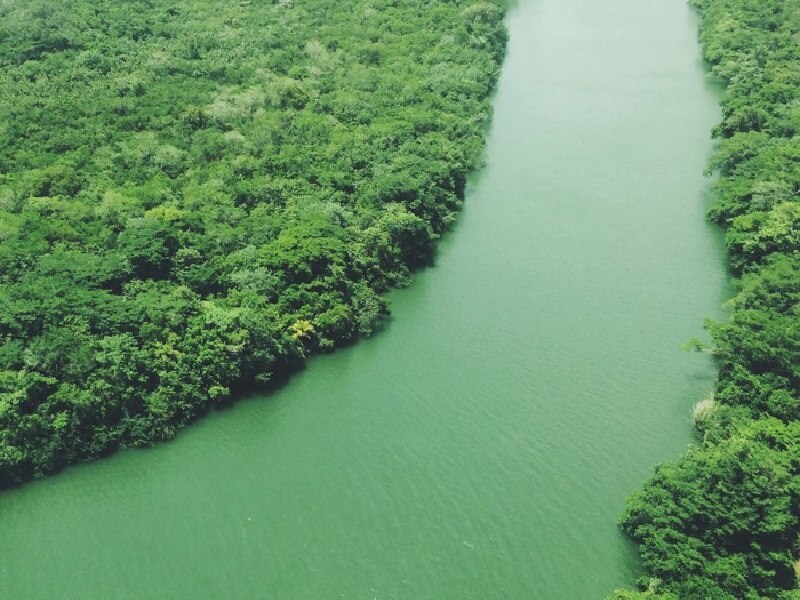
We took a helicopter ride this weekend overseeing the natural beauty of Belize. This unique adventure took us over the Maya Mountains, which practically covers the lower half of Belize. This trip can be taken from Belize airport straight to Ka’ana’s own on site helipad.
It comprises of the Blue Hole National Park (665 ac.), (not to be confused with the “Blue Hole” atoll in the Barrier Reef), the Chiquibul National Park (265,262 acres) and Caracol, the Cockscomb Wildlife Sanctuary and Jaguar Reserve (96,000 acres), the Five Blues Lake National Park (4,060 ac.), the Mountain Pine Ridge Forest Reserve and the Colombia Forest Reserve.
Next up, our eyes were glued to a stunning waterfall somewhat hidden in a crescent of a large mountain. This is actually the largest waterfall in Belize and in Central America; called 1000 ft Falls. This has recently been proclaimed a National Monument and has been opened to the public. Even though the name suggest otherwise, this waterfall is closer to 1,600 feet. This isn’t the only waterfall- there’s many around this area.
After viewing all these amazing waterfalls, we then flew over Caves Branch where we were able to see the beauty of the river as it flows through the cave system. This area encompasses 58,000 acres that are situated beneath a 100 ft rainforest canopy and is bordered by turquoise waters of Caves Branch River.
We then flew across the Sibun Forest Reserve and finally the Southern and Northern Lagoons as we headed for our final landing on the helipad at Ka’ana Resort with these unforgettable images forever imprinted in our heads.
Today marks exactly one month before the predicted “End of the World”- at least according to the Maya Calendar- and we want you to end it with a bang (That is if it really ends, anyway!) Here’s our list of suggestions of the most memorable things you can do here in Belize!
“Ka’ana Resort is located inland in the heart of the mountains and jungle, and what a change it was from San Pedro! The resort was 5-star quality with excellent service, attention to detail, and our room got upgraded too!”
Read more about what this special couple had to share in their review.
The whale shark is the largest fish in the world, and one of the largest creature of any kind alive today. They are most often seen in Belize from Placencia or Hopkins. Unfortunately, since whale sharks are night feeders, there really are no guarantees as to when they show up.
3 or 4 days before and after the full and new moons in April and May are the best times to interact with the sharks, they are often sighted through the summer months as well. They roam up and down the coast, the Gladden Spit area about 26 miles off the coast of Placencia is known to host large concentrations of whale sharks during April and May when Mutton and Dog Snappers are spawning (the whales ingest the spawn as food).
Despite their size, whale sharks are a remarkably gentle and curious creature. The whale shark’s gentle natures makes swimming with them a special treat for divers and snorkelers. The whale shark’s curiosity even pulls fishing parties into its thrall. We have sometimes had whale sharks seem to be asking to be petted as they glide alongside our fishing boats.
An opportunity to share the water with a creature larger than a school bus does not come often in life – and is definitely not soon forgotten!
Lamanai means “submerged crocodile” in the Maya language and it’s also the name of the third largest, and possibly most interesting, archeological site in Belize.
Located in the Orange Walk District, the Lamanai temple complex sits atop the western bluff of the New River Lagoon and is surrounded by pristine rainforest.
Lamanai was occupied continuously for over 3,000 years and it’s remoteness contributed to it’s continuous occupation, well beyond most other Maya sites, until at least 1,650 AD.
Set in tropical forest, and providing spectacular views from several of its large temples, Lamanai provides a unique experience into the culture of the Maya and the biological diversity of the tropical forest.
Lamanai features the second largest Pre-Classic structure in the Maya world and unlike other ruins, much of Lamanai was built in layers where successive populations built upon the temples of their ancestors, instead of destroying them.
Although hundreds of ruins are said to remain unexcavated in the nearby jungle, three of the most impressive temples have been renovated: the Jaguar Temple, named for its boxy jaguar decoration; the Mask Temple, adorned by a 13-foot stone mask of an ancient Maya king; and the High Temple, offering visitors a panoramic view from its summit.
What remains of two 16th century Catholic missions are also nearby. Maya natives rebelled and burned the churches to the ground as part of a regional uprising. A make-shift Maya stelae, standing in front of what remains of one church, is widely interpreted as renouncing all allegiance to Christianity.
The site’s protected status provides for an abundance of wildlife inside the park. There are a growing number off howler monkeys that make Lamanai their home and you will most likely see them peering down through the branches as you wander the trails. In addition, the marshlands around the lagoon supports many species of water birds and wildlife, including crocodiles.
NYtimes article on travelers seeking bespoke itineraries, “There is a surge of people looking for the meaningful experience..” Be sure to check out our meaningful experiences and how you can participate here .
Imagine you’re hiking back from a waterfall. You swam a little, and now need a disco nap… Luckily your backpack comes with a secret compartment and a hammock in it. Crisis averted!
Get your VSTR Nomadic Pack By Partners & Spade here.
Location: Big Rock Falls is 45minutes away from Ka’ana, see where else you can hike here.